Showing posts with label Misc. Show all posts
Showing posts with label Misc. Show all posts
Friday, November 19, 2010
Inside the science of how dogs think
Sit! Shake! Quit barking! Get off the couch! Go find your toy! Ever wonder what your dog is thinking as it gazes at you while you are barking commands?
Duke University's Canine Cognition Center in Durham, North Carolina, is one of the few labs in the country focused on how dogs think. "We're excited about describing the psychology of our dogs," says professor Brian Hare, the lab's director. "Different dogs solve different problems differently. And what we want to understand is: What is it that either makes dogs remarkable as a species or what is it that constrains the ability of dogs to solve problems?"
To test the dogs' ability, Hare and a team of graduate students put dogs through a variety of games similar to those you might play with young children.
"We don't want to look at cute pet tricks. What we want to know is, what does the dog understand about its world?" Hare said. Hare has been analyzing our four-legged friends for about 15 years. He says dogs have figured out how to read human behavior and human gestures better than any other species has, even chimpanzees.
"The way they think about their world is that people are superimportant and they can solve almost any problem if they rely on people," says Hare. Children start relying on adults' gestures when they're about a year old. That's about the same age that dogs start to recognize and rely on humans, too, Hare says. When both I and Hare tried to direct Hare's dog Tazzie to a cup that had a treat in it, Tazzie took his master's cue and went toward the cup. I was a stranger to Tazzie, so the dog didn't rely on my information.
"He's grown up with me," says Hare. "We do lots of stuff together. He's never met you before, so he's saying, look, if they're both telling me where to go, I'm going to trust the guy who I'm with all the time." According to Hare, this proves dogs are complex social animals who understand they have different relationships with different people. "They really narrow in and pay attention to you and they want to know what it is about the world that you can help them with," he says.
Researchers at Duke are studying dogs to better understand their limitations. If they can identify why dogs make mistakes, they believe they can help them improve. That could mean making dogs better at working with people with disabilities or better at working with the military.
"They are a very different species and they think about the world differently than we do. And we need to figure out what are the constraints on how they solve problems, how is it that they think differently from us. And I think that we're going to be able to have a much, even richer relationship with dogs than we already do if we figure all that out," says Hare. The professor says even though domestication has made dogs smarter, they are not perfect. Still, they're so smart, he says, that they can understand the principle of connectivity.
"They know they're connected on a leash and [dogs reason] 'Well, now I have to listen, because if I don't do what you say you can stop me. Where if I'm ... not on a leash, well, yeah, I know the command but I don't have to listen to you now,'" explains Hare.
And just like children, dogs also understand that if you turn your back, they can misbehave, especially after their owners have told them not to do something. "Your dog takes the food you just told it not to take, and you're really upset because your dog disobeyed you, and you think that your dog is not obedient. Well, no, no, no, your dog was obedient but it realized that it could get away with it," says Hare.
At the end of the day, dogs may rely on humans, but they also use their skills to manipulate their owners and the world they live in. And even though dog owners like to think they're in command, the professor says it may actually be Fido who is really in charge.
(via CNN)

Saturday, November 13, 2010
Abandoned Dog Recovers from Hairy Situation

When Ripley the poodle was found by shelter staffers, they couldn't tell if the little pup was male or female. With fur so badly matted that the creature hardly resembled a dog, it was one of the worst cases rescuers in Houma, La., had ever seen.
Ripley, who turned out to be male, was discovered in a quarry outside a southern Louisiana shelter on Oct. 18. After he was recovered, staffers contacted My Heart's Desire, a private rescue group that helps last-chance pets. "We don't know if someone put him there, or if he wandered there," My Heart's Desire co-director Tracey Lapeyrouse tells PEOPLEPets.com. "We had no clue what the deal was. But we immediately started rounding people up, knowing this was going to be a huge undertaking financially and time-wise."
Since Ripley had been covered in this mess of fur for so long, he didn't know how to react to touch, nor did he understand how to walk on grass — he hadn't actually felt the ground in months.
To clean him up, veterinarians at a nearby clinic sedated Ripley, then shaved a whopping 2.5 lbs. of fur off his 7.5-lb. body. Though he still has some sores, he's recovering well, and now it's "just a matter of letting his skin breathe and heal," Lapeyrouse says.
As for his other issues, "he's done a complete turnaround in just the couple of weeks we've had him," Lapeyrouse says. He's gained a little weight, and craves human attention. "He realizes that people are good, and loves for you to pick him up and snuggle with him," Lapeyrouse shares. Though Ripley, estimated to be 2, isn't available for adoption yet, My Heart's Desire has had dozens of inquiries and is working on finding him a forever home — preferably one without children or large dogs.
When Ripley does join his new family, he'll be coming with a years' worth of grooming, food, toys and more from the PETCO Foundation and Ripley's Believe It or Not. Since the pup was unnamed when he was rescued, staffers decided to call him Ripley because "they just couldn't believe there was a dog under there," Lapeyrouse says. When Ripley's got wind of the story, they stepped in, offering to help sponsor the pooch for a year.
"We're so grateful. They want to follow him, the news wants to follow him, and we obviously want to follow him, too," Lapeyrouse says. "We didn't know the beginning of his story, but we know the middle, and hopefully, we'll know the happy end."
(via People Magazine)
Tuesday, November 09, 2010
2011 Rose Parade Open Casting Call for Dogs!!

Sunday, November 07, 2010
Thursday, August 28, 2008
The Dog Days of Summer
 Everyone knows that the “dog days of summer” occur during the hottest and muggiest part of the season. Webster defines “dog days” as:
1 : the period between early July and early September when the hot sultry weather of summer usually occurs in the northern hemisphere
2 : a period of stagnation or inactivity
But where does the term come from? Why do we call the hot, sultry days of summer “dog days?”In ancient times, when the night sky was unobscured by artificial lights and smog, different groups of peoples in different parts of the world drew images in the sky by “connecting the dots” of stars. The images drawn were dependent upon the culture: The Chinese saw different images than the Native Americans, who saw different pictures than the Europeans. These star pictures are now called constellations, and the constellations that are now mapped out in the sky come from our European ancestors.
They saw images of bears, (Ursa Major and Ursa Minor), twins, (Gemini), a bull, (Taurus), and others, including dogs, (Canis Major and Canis Minor).
The brightest of the stars in Canis Major (the big dog) is Sirius, which also happens to be the brightest star in the night sky. In fact, it is so bright that the ancient Romans thought that the earth received heat from it. Look for it in the southern sky (viewed from northern latitudes) during January.
In the summer, however, Sirius, the “dog star,” rises and sets with the sun. During late July Sirius is in conjunction with the sun, and the ancients believed that its heat added to the heat of the sun, creating a stretch of hot and sultry weather. They named this period of time, from 20 days before the conjunction to 20 days after, “dog days” after the dog star.
The conjunction of Sirius with the sun varies somewhat with latitude. And the “precession of the equinoxes” (a gradual drifting of the constellations over time) means that the constellations today are not in exactly the same place in the sky as they were in ancient Rome. Today, dog days occur during the period between July 3 and August 11. Although it is certainly the warmest period of the summer, the heat is not due to the added radiation from a far-away star, regardless of its brightness. No, the heat of summer is a direct result of the earth's tilt.
Tuesday, June 24, 2008
An Estimated 17 million U.S. Dogs Are Overweight
 Not my Little Edie of course. At 10 pounds she's right on for her breed. However, millions of dogs in the United States are overweight or obese, according to animal experts.
Up to 40 percent, or 17 million dogs, are carrying excess weight which could cause future health problems, but many of their owners are not even aware of it.
"What we've found in talking with dog owners is that it's difficult for them to see the reality that their own pet may be overweight or obese, instead of just chubby or fluffy," said Lisa Peterson of the American Kennel Club Humane Fund.
"Studies are indicating that there are approximately 17 million dogs out there that may be overweight or obese. It is a troubling statistic that dogs are gaining weight, just as humans are," she added in an interview.
While an extra 10 pounds on a man or woman can be a bit uncomfortable and mean loosening the belt or a bigger dress size, for a normal 40-pound dog the excess could put it 25 percent over its ideal weight.
To help dog owners identify their overweight canines, the AKC is urging owners to check their dog's weight through the Web site www.stopcanineobesity.com. Up to 4,000 veterinarians across the United States are participating in the program to raise awareness of the problem, according to Peterson.
"About 30 percent of dog owners may not even know their dogs are overweight so this is a great way to start a conversation about their dog's weight," she said. The main cause of obesity in dogs, as in humans, is overeating and insufficient exercise.
Neutering, hormonal disorders and slow metabolism can also cause dogs to pile on the pounds. Canine middle-age spread usually occurs by about the age of five or six years old.
Certain breeds including Beagles, Cocker Spaniels, Collies, Shelties, Basset Hounds, Dachshunds, Labradors and Golden Retrievers are prone to excess weight. Like humans, overweight dogs are more at risk of developing heart or respiratory disease, joint problems, arthritis and diabetes.
Friday, June 13, 2008
Flower Power

 Nana B. sent me these amazing pictures of dogs made out of flowers! They are so realistic, aren't they?
 Saturday, May 17, 2008
Cat Fact or Cat Fiction???

Humans have always found felines somewhat of a mystery. Therefore, it only goes to reason that cats have endured many (and oftentimes preposterous) myths about them for centuries. Many of these tales have been absolutely absurd, while many others are believed by a fairly large number of people.
Of course, since a myth is a type of story or legend, many other people wonder if these kitty chronicles are absolutely true, partially true or completely false. Below are just a few of the many myths – complete with the truths and/or falsehoods shadowing them – behind the mysterious creature known as the cat.
MYTH: Cats only purr when they are happy.
FACT: While it is a well-known fact that cats do indeed purr when they're happy, this isn’t always the case. Oftentimes, they will purr when they are in pain and, believe it or not, even when they are dying. Also, cats have been known to purr when they are giving birth – which is an extremely distressing, laborious and excruciating experience. Unbeknownst to most humans, a feline’s purr is more an expression of emotion than an expression only of happiness.
MYTH: All Tortoiseshell cats are females.
FACT: While the immense majority of Tortie cats are indeed female, an occasional male, although extremely rare, will show up in a litter of kittens. However, the vast majority of these multi-colored males are sterile and cannot reproduce.
MYTH: Cats will “suck the breath” out of a newborn if it gets in the infant’s crib.
FACT: This myth simply is not true and is an old wive’s tale. The reason people have believed this legend is much simpler than a cat “sucking the life” out of a baby. Although infants have been found deceased while a cat is in its crib, the truth of the matter is that kitty was only cuddling with its little pal and accidentally smothered the little one by stretching out and covering the infant’s mouth and nose. In no way is this an intentional act. To keep this from happening, however, parents should NEVER leave the family cat (or dog) unsupervised around their child.
MYTH: Black cats bring bad luck and have long been associated with witchcraft.
FACT: For a long time in Europe pagan religions – such as witchcraft – were the dominant belief and all cats, but especially black ones, were supposedly the witches’ comrades. During the rise of the Christian religion in Europe, the church decided that witchcraft was evil. And since the church attributed cats to witches, cats were thereby deemed evil by proxy. Also, since felines are primarily nocturnal and are unbelievable stalkers – allowing them to sneak around during the night – made humans extremely paranoid. So, being associated with the darkness of night, unfortunately didn't help their image since the color “black” has always been associated with evil – due to our ancestor's misinterpreted fear of the night.
MYTH: Red/orange cats are almost always male.
FACT: While the statistics are high that a red/orange tabby is usually male, the female gene sometimes sneaks in and creates a somewhat unusual red/orange female – although it seems most cat owners have had at least one of these supposedly “uncommon” cats in their lifetime. Perhaps their uncommonness is becoming more common.
MYTH: Cats always land on their feet – no matter how far they fall.
FACT: It is true that cats can twist their bodies around while in the air if falling from a great distance and, most times, will land on their feet (which probably doesn’t feel too good on their precious paws). However, broken bones are a concern from a fall from a balcony in someone’s apartment. Owners must NEVER allow their cats out on a balcony unless there is some kind of screening in place and there is no chance for kitty to escape. Because the worst accidents usually occur from city high-rise buildings, this phenomenon has been termed “High Rise Syndrome” by veterinarians. Cats who fall from shorter distances, however, may become seriously injured because they do not have enough time to twist their bodies around and “right” themselves, thus they may not land on their feet.
Of course, since a myth is a type of story or legend, many other people wonder if these kitty chronicles are absolutely true, partially true or completely false. Below are just a few of the many myths – complete with the truths and/or falsehoods shadowing them – behind the mysterious creature known as the cat.
MYTH: Cats only purr when they are happy.
FACT: While it is a well-known fact that cats do indeed purr when they're happy, this isn’t always the case. Oftentimes, they will purr when they are in pain and, believe it or not, even when they are dying. Also, cats have been known to purr when they are giving birth – which is an extremely distressing, laborious and excruciating experience. Unbeknownst to most humans, a feline’s purr is more an expression of emotion than an expression only of happiness.
MYTH: All Tortoiseshell cats are females.
FACT: While the immense majority of Tortie cats are indeed female, an occasional male, although extremely rare, will show up in a litter of kittens. However, the vast majority of these multi-colored males are sterile and cannot reproduce.
MYTH: Cats will “suck the breath” out of a newborn if it gets in the infant’s crib.
FACT: This myth simply is not true and is an old wive’s tale. The reason people have believed this legend is much simpler than a cat “sucking the life” out of a baby. Although infants have been found deceased while a cat is in its crib, the truth of the matter is that kitty was only cuddling with its little pal and accidentally smothered the little one by stretching out and covering the infant’s mouth and nose. In no way is this an intentional act. To keep this from happening, however, parents should NEVER leave the family cat (or dog) unsupervised around their child.
MYTH: Black cats bring bad luck and have long been associated with witchcraft.
FACT: For a long time in Europe pagan religions – such as witchcraft – were the dominant belief and all cats, but especially black ones, were supposedly the witches’ comrades. During the rise of the Christian religion in Europe, the church decided that witchcraft was evil. And since the church attributed cats to witches, cats were thereby deemed evil by proxy. Also, since felines are primarily nocturnal and are unbelievable stalkers – allowing them to sneak around during the night – made humans extremely paranoid. So, being associated with the darkness of night, unfortunately didn't help their image since the color “black” has always been associated with evil – due to our ancestor's misinterpreted fear of the night.
MYTH: Red/orange cats are almost always male.
FACT: While the statistics are high that a red/orange tabby is usually male, the female gene sometimes sneaks in and creates a somewhat unusual red/orange female – although it seems most cat owners have had at least one of these supposedly “uncommon” cats in their lifetime. Perhaps their uncommonness is becoming more common.
MYTH: Cats always land on their feet – no matter how far they fall.
FACT: It is true that cats can twist their bodies around while in the air if falling from a great distance and, most times, will land on their feet (which probably doesn’t feel too good on their precious paws). However, broken bones are a concern from a fall from a balcony in someone’s apartment. Owners must NEVER allow their cats out on a balcony unless there is some kind of screening in place and there is no chance for kitty to escape. Because the worst accidents usually occur from city high-rise buildings, this phenomenon has been termed “High Rise Syndrome” by veterinarians. Cats who fall from shorter distances, however, may become seriously injured because they do not have enough time to twist their bodies around and “right” themselves, thus they may not land on their feet.
Wednesday, May 14, 2008
I Have Positive "Chi" huahua
 Pet parents are practicing good Feng Shui—whether they know it or not!
“Pets themselves are Feng Shui,” according to expert, Yvonne Phillips, author of the book Feng Shui ABC. "Pets emit a strong, positive form of energy in your home because they are constantly in motion. There is no better Feng Shui for your home than having an animal run around spreading positive chi."
Feng Shui (pronounced fung shwey) is an ancient Chinese practice dating back some 3,000 to 5,000 years. The words translate literally to “wind-water” in English and the practice is based upon the belief that careful study and use of the laws of astronomy and geography will result in positive Qi, or “Chi,” improving one’s life. Chi (pronounced “chee”) literally means “air” but in feng shui, it means ‘flow of energy.’
Critics consider it a pseudoscience, but followers are convinced of its powerful effect on achieving Chi. In the United States, Feng Shui has gained popularity as a thoughtful practice of arranging objects in our homes (such as furniture) to achieve harmony with our environment.
“Pets already possess upbeat, positive energy,” she explains. “And best of all, they generally want to be in the same room you’re in, which generates ‘good energy’ around you whenever you’re at home.”
Feng Shui is often referred to as a form of therapy, because of it’s believed ability to enhance our spirit and wellbeing when practiced correctly. Phillips assures that feng Shui can be effective for pets too.
“Look at the area where your pet likes to hang out,” encourages Phillips. “Our animals are drawn to the best energy in a room or a home.”
She goes on to explain that if you generate positive energy in your home, you can enhance your pet’s overall health and happiness—without having to rearrange or redecorate your home.
Though the study and practice of Feng Shui can seem complex for beginners, Phillips suggests that pet parents simply arm themselves with careful observation and common sense to create good Chi for our pets.
Critics consider it a pseudoscience, but followers are convinced of its powerful effect on achieving Chi. In the United States, Feng Shui has gained popularity as a thoughtful practice of arranging objects in our homes (such as furniture) to achieve harmony with our environment.
“Pets already possess upbeat, positive energy,” she explains. “And best of all, they generally want to be in the same room you’re in, which generates ‘good energy’ around you whenever you’re at home.”
Feng Shui is often referred to as a form of therapy, because of it’s believed ability to enhance our spirit and wellbeing when practiced correctly. Phillips assures that feng Shui can be effective for pets too.
“Look at the area where your pet likes to hang out,” encourages Phillips. “Our animals are drawn to the best energy in a room or a home.”
She goes on to explain that if you generate positive energy in your home, you can enhance your pet’s overall health and happiness—without having to rearrange or redecorate your home.
Though the study and practice of Feng Shui can seem complex for beginners, Phillips suggests that pet parents simply arm themselves with careful observation and common sense to create good Chi for our pets.
Sunday, May 11, 2008
Chee-Wow-Whaaaaatttt????
The trailer is finally here for Beverly Hills Chihuahua. You know, the movie they made without Little Edie. Emphasis on the "wow" cause wow, did they really get ripped off. Edie can dance like that. She can sing. She can talk. She just learned how to swim on her vacation. She totally moves within the inner circles of the most powerful people on the planet and I'm sure she can beat a drum if you put one in front of her. She's like one of those triple threat celebrities. The ones that can sing, dance and act. She's the complete package. She'll get her big audition one day. You just wait.
Oh and get a load of the voice of Edward James Olmos in the beginning "My name is Papi"???? Gee......how original. Papi. Does he fall in love with Mami??
The plot of this movie still escapes me but I'm sure it will be up for an Oscar nom so I'm going to go online now and see if I can order my advance tickets.
Oh and get a load of the voice of Edward James Olmos in the beginning "My name is Papi"???? Gee......how original. Papi. Does he fall in love with Mami??
The plot of this movie still escapes me but I'm sure it will be up for an Oscar nom so I'm going to go online now and see if I can order my advance tickets.
Friday, May 09, 2008
Your Pet's Carbon Pawprint

I've been doing my best to reduce my carbon footprint. Recycling, using compact fluorescent bulbs, unplugging unused appliances. But what about Jake and Little Edie? What can they do to help?? Here's 11 tips on how to help your pet reduce their carbon pawprint:
1-If you have a choice (if your pet doesn’t require prescription foods), buy pet foods produced closer to home. Though manufacturer’s labels often tell only part of the story, foods packaged nearby tend to require less fuel.
2-Use clay or sand litters for your cats. It takes less petroleum to bring these products to market. Even better, use shredded newspaper to save on shipping. For exotics, buy the recycled, biodegradable shavings instead of the cedar or cypress chips (they weigh less, too, so shipping's cheaper).
3-Cook for your pets or supplement their commercial diets with locally grown meats and produce. (Easier said than done, I know.)
4-Feed dry over canned foods, if possible. Less packaging material is required and the shipping differences are dramatic. With today’s high quality kibble, you need not fear your pets are losing out, health-wise (as long as you select wisely).
5-Compost your pets’ leftover foods instead of trashing them—and don’t ignore the fertilizer potential of some of our less traditional pets’ droppings. My goats, for example, produce excellent plant power via poop.
6-Don’t excessively warm or chill your home for your pets while you’re out. They mostly don’t mind the difference and they’ll find the warm and cool spots in your home easily if you set the thermostat at a balmy 80-85 in the summer and a snug 60-65 in the winter (if it's cold where you live).
7-Use stainless steel forever-bowls for your pets. You’ll never need to replace them.
8-Brush your pets daily to reduce your vacuum energy needs (and make her coat shine, while you’re at it). Consider storing her fur to have it spun it into yarn for your next knitting project (you can find online sources for this service).
9-Turn off the lights and the TV while you’re away. They see better in the dim light than we do. If your pets require soothing sound therapy, use a simple CD player or radio.
10-Recycled cardboard scratching posts are excellent and re-recyclable. Give them a go instead of the standard carpet-coated kind.
11-Never buy exotics sourced from the wilds and get your pets locally; there are are enough throwaways and rescues around to last us all through 2020.
Saturday, April 26, 2008
Dog Poison Alert

Frank's Nana B. sent me an email about a dog who died after eating raisins. Did you know raisins were toxic for dogs? It got me thinking that I needed to brush up on my knowledge of what you can and can't feed a dog. Keep this list of 25 items in mind before you give your loved one a bite:
1. Onions (Both onions and garlic contain the toxic ingredient Thiosulphate. But onions are more of a danger. Many dog biscuits contain *small* amounts of garlic – garlic contains less of this toxin so huge amounts would need to be consumed to be toxic. And, by the way, this poison builds up the system – it can be toxic in one large dose – or with repeated consumption of small amounts.)
2. Chocolate (Chocolate contains Theobromine, a compound that is a cardiac stimulant and a diuretic. This can be fatal to dogs.)
3. Grapes (Grapes are dangerous because of an unknown substance which is toxic to dogs – affects canine’s kidneys)
4. Raisins (See above.)
5. Most Fruit Pits and Seeds (Contain Cyanogenic Glycosides resulting in cyanide poisoning – though the fruit itself is OK.)
6. Macadamia Nuts (Macadamia nuts contain an unknown substance that is toxic to dogs.)
7. Bones (Most bones should *not* be given (especially chicken bones) because they can splinter and cause laceration of the digestive system and/or become lodged in your pet’s throat – so they also pose a choking hazard.)
8. Potato Peelings and Green Potatoes (Contain Oxalates, which can affect the digestive, nervous, and urinary systems.)
9. Rhubarb leaves (See above.)
10. Broccoli (Broccoli is only toxic in large quantities.)
11. Green parts of Tomatoes or Green Potatoes (Contain oxalates, which can affect the digestive, nervous, and urinary systems.)
12. Yeast Dough (Yeast Dough can produce gas and swell in your pet’s stomach – leading to rupture of the digestive system)
13. Coffee, Coffee Grounds, Tea, Soft Drinks (Coffee, tea, & most soft drinks are dangerous due to the caffeine.)
14. Beer/Wine/Alcohol of any kind (Alcohol of any kind could lead to coma or even death.)
15. Human Vitamins (Human vitamins, especially those containing iron, can cause damage to the lining of the digestive system as well as cause kidney and liver damage)
16. Moldy or Spoiled Food (Goes without saying.)
17. Persimmons (Persimmons can cause intestinal blockage)
18. Raw Eggs and Raw Fish (Raw eggs and some raw fish can cause Salmonella poisoning.)
19. Salt, Baking Soda, Baking Powder (In large amounts these can cause an electrolyte imbalance – and severe electrolyte imbalances can lead to muscle spasm or even congestive heart failure.)
20. Mushrooms (Mushrooms may contain toxins which could cause liver and kidney damage)
21. Sugar-Free Foods (Sugar-free foods containing Xylitol have been found to cause liver failure in some dogs.)
22. Nutmeg (Nutmeg can cause tremors, seizures, and central nervous system damage.)
23. Excessive Fatty Foods (Excess fatty foods can cause Pancreatitis.)
24. Avocado (All parts of the avocado and avocado tree are toxic to dogs.)
25. Diary Products (Dairy products don’t usually pose a great danger; but many dairy product have high fat content (see number 23) – and many pets are lactose intolerant – some pets more than others. Lactose intolerance leads to gas and diarrhea; though small amounts of yogurt and cheese are usually fairly well tolerated.)
Thursday, April 24, 2008
OctaPUSSY
 Hex is a typical, playful 6-week-old kitten. But that's where it ends. He has six legs. His owner, Barbara Flores, says the vets didn't think he would live this long due to his condition.
 Veterinarians believe Hex possibly had a Siamese twin that never fully developed. They plan to operate and believe he could survive the surgery. Hex is an only child-- the single cat in his litter.
The operation to remove the appendage isn't cheap, $2,400 - $3,000, which is a bit steep for the Flores family. Anyone who's liked to donate to the cause can contact:
Veterinary Specialists of South Florida
ATTN: Aimee Griswald
99410 Stirling Road
Cooper City, Florida 33024
Saturday, April 19, 2008
He Must Be Stopped....
I received an email from Polly with a lot of bad words in the subject line. Certainly caught my attention. It was about this Costa Rican "artist" that took a dog off the street and tied him up and allowed him to starve to death. This was done as an "art installation". WTF??????? This pig considers himself an artist?? Furthermore, dozens of people saw this installation and did NOTHING. Again, WTF????? And where does the Cotsa Rican government stand on this; that they would allow this to happen???
I'd like to tie this scumbag up and let HIM starve to death. If you can believe this, he has actually been invited to repeat this installation again. Please, please, please sign the petition to stop this idiot. You can do so at the following link. And please pass this along to everyone you know. Thanks, Polly.
http://www.PetitionOnline.com/ea6gk/
Saturday, April 05, 2008
RIP Sophie Winfrey
I told you!! I knew Oprah would do a show dedicated to Sophie. Karen confirmed it by posting a comment when I posted about Sophie's passing.
I laid in bed last night and cried while I watched yesterday's episode. I cried throughout the ENTIRE episode. The beginning featured this video which was a dedication to Sophie that brought Oprah to tears but the rest of the show was about the horror that occurs every day all over the Nation in puppy mills.
In puppy mills all over the Nation, dogs are treated like a commodity. Like cattle. They are sold at auctions then kept in cages their whole lives, just to breed as many puppys as they can during each heat cycle so the puppies can then be sold to pet stores and breeders. Many of the dogs can't even walk because they've never been out of the cages.
When they showed the process of how one shelter chooses every day how many dogs they will put down and then show them putting the dogs to sleep, putting them in bags and throwing them in a dumpster I lost it. It makes me cry even as I type this. It's horrifying, inexcusable and it's a shame that this goes on in our very own country while at the same time billions are being spent every year on our pets.
Here is a link to Oprah's website where you can read about the episode, see pictures and see how you can help. Please, please do what you can. Spay and neuter your pets and consider a shelter before going to a pet store or a breeder. If you saw this episode it most certainly weighed very heavily on you.
http://www2.oprah.com/tows/pastshows/200804/tows_past_20080404.jhtml?promocode=incl20080404TD
I laid in bed last night and cried while I watched yesterday's episode. I cried throughout the ENTIRE episode. The beginning featured this video which was a dedication to Sophie that brought Oprah to tears but the rest of the show was about the horror that occurs every day all over the Nation in puppy mills.
In puppy mills all over the Nation, dogs are treated like a commodity. Like cattle. They are sold at auctions then kept in cages their whole lives, just to breed as many puppys as they can during each heat cycle so the puppies can then be sold to pet stores and breeders. Many of the dogs can't even walk because they've never been out of the cages.
When they showed the process of how one shelter chooses every day how many dogs they will put down and then show them putting the dogs to sleep, putting them in bags and throwing them in a dumpster I lost it. It makes me cry even as I type this. It's horrifying, inexcusable and it's a shame that this goes on in our very own country while at the same time billions are being spent every year on our pets.
Here is a link to Oprah's website where you can read about the episode, see pictures and see how you can help. Please, please do what you can. Spay and neuter your pets and consider a shelter before going to a pet store or a breeder. If you saw this episode it most certainly weighed very heavily on you.
http://www2.oprah.com/tows/pastshows/200804/tows_past_20080404.jhtml?promocode=incl20080404TD
Friday, April 04, 2008
Pet Psychics: A Growing Trend

Have you ever wondered what your cat is thinking? Is she sick? How can get my dog to stop biting? Is he happy with the new organic pet food?
Increasingly, pet lovers are turning to pet psychics like Sharon Kurtz for a better understanding of their pets. Kurtz, who can communicate with any animal as well as humans, welcomes people’s interest in learning what their pets have to say, “because the animals want and need to be heard,” she says, “and they definitely have something to say.”
Since her childhood, Kurtz has been able to talk with people and animals, but her mother discouraged such activities. Her decision to offer psychic readings evolved from her work as an emergency room nurse. “Accident victims would sometimes arrive at the hospital emergency room with their pets,” said Kurtz, a registered nurse. “I just knew what the pet was saying.” Her pet psychic services blossomed even further when she became involved in holistic healing practices. More and more people wanted to know what their pets were thinking.
Take Margaret Woodward. She knew her 12-year-old tabby named Jessie Bessie was dying from cancer. Because the veterinarian didn’t even vaccinate her cat, Woodward knew that her cat was probably dying. She watched as Jessie Bessie’s world became smaller and smaller until the cat just rested lightly on the bed, taking water but no food. Woodward called a pet psychic to get a better understanding of her cat’s condition.
From Kurtz, she learned that the pet had no concept of dying and no understanding of disease. “A pet’s world is simple,” said Kurtz. “The cat wasn’t sad about her condition.”
The psychic reading gave Woodward a greater understanding and acceptance of Jessie Bessie’s death. And so, she was able to arrange for a peaceful ending.
Should you contact a pet psychic? “Yes,” said Kurtz, but she notes, “Animal communication is not the same as human communication. Their thoughts are quite simple and direct.
Increasingly, pet lovers are turning to pet psychics like Sharon Kurtz for a better understanding of their pets. Kurtz, who can communicate with any animal as well as humans, welcomes people’s interest in learning what their pets have to say, “because the animals want and need to be heard,” she says, “and they definitely have something to say.”
Since her childhood, Kurtz has been able to talk with people and animals, but her mother discouraged such activities. Her decision to offer psychic readings evolved from her work as an emergency room nurse. “Accident victims would sometimes arrive at the hospital emergency room with their pets,” said Kurtz, a registered nurse. “I just knew what the pet was saying.” Her pet psychic services blossomed even further when she became involved in holistic healing practices. More and more people wanted to know what their pets were thinking.
Take Margaret Woodward. She knew her 12-year-old tabby named Jessie Bessie was dying from cancer. Because the veterinarian didn’t even vaccinate her cat, Woodward knew that her cat was probably dying. She watched as Jessie Bessie’s world became smaller and smaller until the cat just rested lightly on the bed, taking water but no food. Woodward called a pet psychic to get a better understanding of her cat’s condition.
From Kurtz, she learned that the pet had no concept of dying and no understanding of disease. “A pet’s world is simple,” said Kurtz. “The cat wasn’t sad about her condition.”
The psychic reading gave Woodward a greater understanding and acceptance of Jessie Bessie’s death. And so, she was able to arrange for a peaceful ending.
Should you contact a pet psychic? “Yes,” said Kurtz, but she notes, “Animal communication is not the same as human communication. Their thoughts are quite simple and direct.
“Pets focus on the positives rather than the negatives. For example, if you tell Fido not to go on the couch, he only hears “couch.” You should focus on where he should be instead of where he shouldn’t be. They don't understand negatives.”
How is a reading conducted? Surprisingly, just like with humans, pet readings can take place over the telephone. Kurtz only needs the pet’s name. She discourages pet owners from providing elaborate details. Sometimes in homes with multiple animals, pet readings can get confusing. “Pets will just randomly chime in,” said Kurtz. “When this happens, I will ask the other animals step aside.”
How long is a typical psychic reading? It only takes can 15 minutes. Kurtz said, “In that time pets usually tell you everything you need to know.”
Some pet owners turn to psychics to learn about a deceased pet. Kurtz said, “Pets should be allowed time to transition after their death. We, as humans, desperately miss their companionship and can hold them to the earth plane. They need time to “cross over.” Usually this time is from 24 to 48 hours unless they have reached an untimely death in their youth and need a longer time to transition. They will always let the pet psychic know.”
Kurtz offered this final advisory: Come prepared with your questions. “The pet will continue to ‘speak,’ about how much he enjoys car rides but to get meaningful answers, have your questions ready.”
For more information Kurtz can be reached at her website: http://www.intouchtoo.com/.
Sunday, March 30, 2008
We're Back!!!
Hey everybody,
Had to take a little break there! Thanks for hanging in and for all your emails. Lots to catch up on so stay tuned!
Michelle, Little Edie and Jake
Tuesday, February 26, 2008
German Police Dogs To Wear Shoes
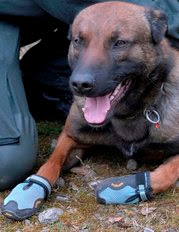
BERLIN - Police dogs in the western city of Duesseldorf will no longer get their feet dirty when on patrol — the entire dog unit will soon be equipped with blue plastic fiber shoes, a police spokesman said Monday.
"All 20 of our police dogs — German and Belgian shepherds — are currently being trained to walk in these shoes," Andre Hartwich said. "I'm not sure they like it, but they'll have to get used to it."
The unusual footwear is not a fashion statement, Hartwich said, but rather a necessity due to the high rate of paw injuries on duty. Especially in the city's historical old town — famous for both its pubs and drunken revelers — the dogs often step into broken beer bottles.
"Even the street-cleaning doesn't manage to remove all the glass pieces from between the streets' cobble stones," Hartwich said, adding that the dogs frequently get injured by little pieces sticking deep in their paws.
The dogs will start wearing the shoes this spring but only during operations that demand special foot protection. The shoes comes in sizes small, medium and large and were ordered in blue to match the officers uniforms, Hartwich said.
"Now we just have to teach the dogs how to tie their shoes," he joked.
(Thanks, Karen)
What if????

Here's the second post in this new "What If ??" series. The premise is.....what if some of these animals mated? These pictures are so well done and they really make you wonder.
Monday, February 25, 2008
Petco To Reduce Number Of Pets Sold In Stores

Petco has announced that they will reduce the number of animals for sale in its stores nationwide by 30 percent. The company said they are making space for more products as they are trying to tailor stores to local markets.
Petco spokesman Kevin Whalen said the decision was based on the results of a test that started in November 2007. He stated that Petco is taking customer needs into consideration and is aiming to keep animals in stores for a shorter period.
But People for Ethical Treatment of Animals (PETA) said that Petco’s move is because of their investigation of Rainbow World Exotics (RWE) in Hamilton, Texas, one of Petco’s animal suppliers. An undercover PETA investigator recorded abuse and neglect of birds and other animals.
PETA Vice President Daphna Nachminovitch made this statement: “PETCO is taking good steps that should send a ripple through the pet trade industry, but it is astounding that an abusive mill like RWE can still call the nation’s two largest pet supply companies its customers. The decisions by PETCO and PetSmart not to cut ties with RWE make it clear that to them, the bottom line is far more important than ensuring that tens of thousands of animals avoid pain and suffering. PETA wants consumers to know that animals do not generally fare well in the pet trade. Animal shelters and pounds are the place to go when you are ready to offer a loving, responsible home to an animal.”
Whalen responded, “While it will benefit animals, our decision to expand the test program to all of our stores is unrelated to our discussions with PETA.”
Petco spokesman Kevin Whalen said the decision was based on the results of a test that started in November 2007. He stated that Petco is taking customer needs into consideration and is aiming to keep animals in stores for a shorter period.
But People for Ethical Treatment of Animals (PETA) said that Petco’s move is because of their investigation of Rainbow World Exotics (RWE) in Hamilton, Texas, one of Petco’s animal suppliers. An undercover PETA investigator recorded abuse and neglect of birds and other animals.
PETA Vice President Daphna Nachminovitch made this statement: “PETCO is taking good steps that should send a ripple through the pet trade industry, but it is astounding that an abusive mill like RWE can still call the nation’s two largest pet supply companies its customers. The decisions by PETCO and PetSmart not to cut ties with RWE make it clear that to them, the bottom line is far more important than ensuring that tens of thousands of animals avoid pain and suffering. PETA wants consumers to know that animals do not generally fare well in the pet trade. Animal shelters and pounds are the place to go when you are ready to offer a loving, responsible home to an animal.”
Whalen responded, “While it will benefit animals, our decision to expand the test program to all of our stores is unrelated to our discussions with PETA.”
Subscribe to:
Posts (Atom)